
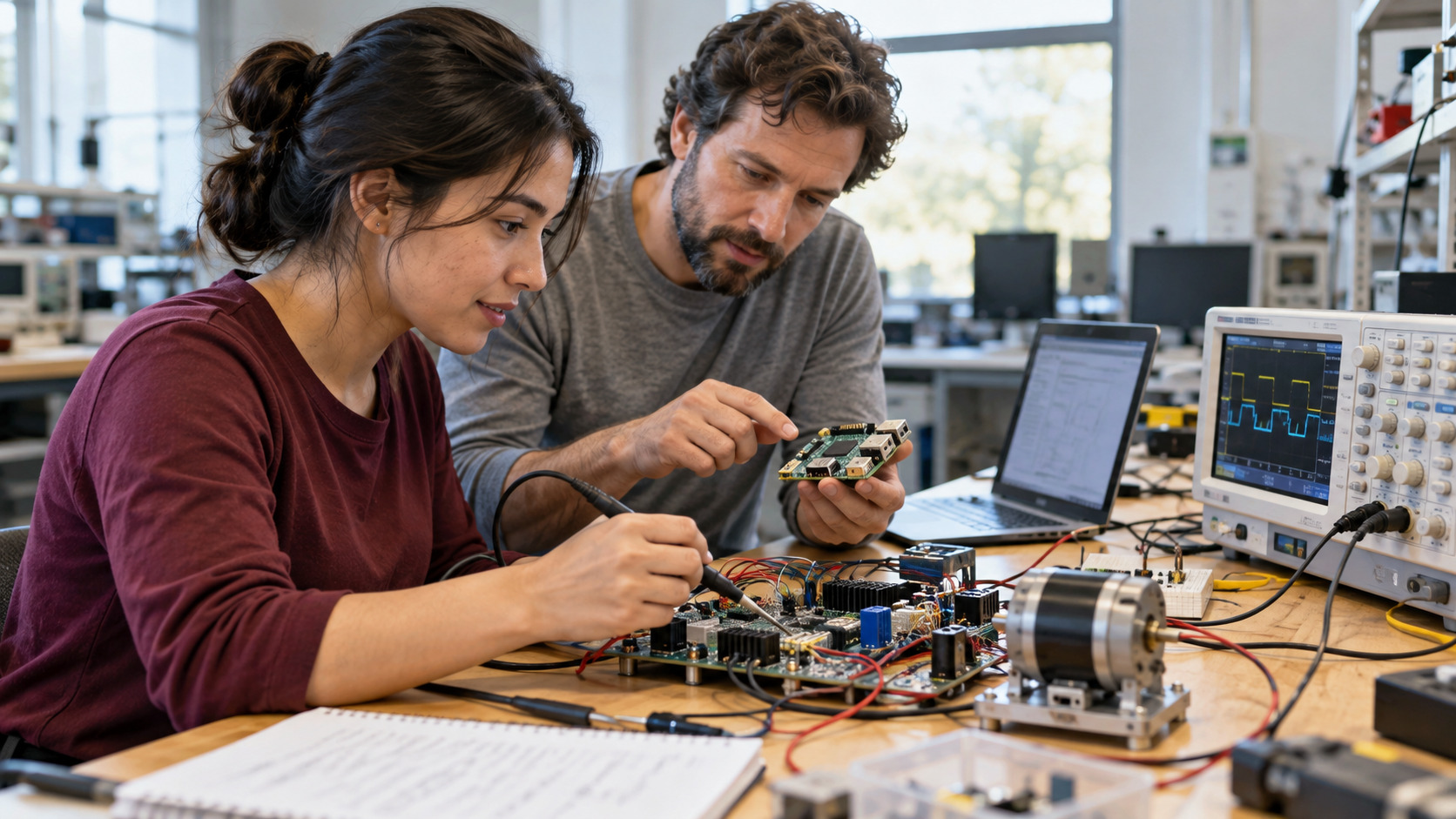
The primary distinction between a Bachelor of Science (BS) in Electrical and Computer Engineering (ECE) and a Bachelor of Science (BS) in Electrical Engineering (EE) lies in their scope and focus. While both degrees share a foundational understanding of electrical principles, an ECE program integrates a substantial curriculum in computer science and engineering, providing a broader skill set that spans both hardware and software. An EE program, conversely, tends to delve deeper into traditional electrical engineering domains, such as power systems, electromagnetics, and signal processing, with less emphasis on computing. Think of it like this: if Electrical Engineering is a powerful telescope focused on the vast universe of electricity, Electrical and Computer Engineering is a versatile binocular, allowing you to see both the electrical universe and the intricate landscape of computing with clarity.
Key Takeaways
- EE and combined ECE degrees share mathematics, physics, and circuit foundations, but their computing content and specialization options can differ.
- Compare required courses and electives rather than relying on the department or degree name alone.
- Hardware–software work in embedded devices, robotics, and connected systems draws on both electrical and computing skills.
Understanding the Foundational Differences in Curriculum
When you consider pursuing either an EE or ECE degree, the coursework is where the divergence becomes most apparent. Both fields are built upon a robust foundation of mathematics and physics. You’ll encounter courses like calculus, differential equations, linear algebra, and classical mechanics regardless of which path you choose. However, the subsequent specialization defines the core difference.
Core Electrical Engineering Courses
In a traditional EE program, your curriculum will heavily emphasize subjects directly related to the generation, transmission, and application of electricity.
- Circuits and Electronics: This is the bedrock. You’ll learn about passive components like resistors, capacitors, and inductors, and active components like transistors and operational amplifiers. You’ll analyze circuit behavior, design amplifiers, and understand the principles of power conversion.
- Electromagnetics: This area explores the fundamental laws governing electric and magnetic fields. You’ll study Maxwell’s equations, wave propagation, antennas, and microwave circuits. It’s crucial for understanding wireless communication and power transmission.
- Control Systems: This involves designing systems that regulate the behavior of other systems. Think of automated processes in manufacturing, aircraft autopilot systems, or even the cruise control in your car. You’ll learn about feedback loops, stability analysis, and various control strategies.
- Power Systems: This specialization focuses on the generation, transmission, distribution, and utilization of electrical power. You’ll study topics like power grids, renewable energy sources, power electronics, and high-voltage engineering.
- Signal Processing: This deals with the analysis, modification, and synthesis of signals. This includes audio, video, and medical signals. You’ll learn about Fourier transforms, filters, and digital signal processing (DSP) techniques.
Core Computer Engineering Courses
An ECE program, while still covering many EE fundamentals, introduces a significant portion of computer science and engineering topics.
- Digital Logic Design: This is where you learn the building blocks of computers – logic gates, flip-flops, and combinational and sequential circuits. You’ll design and analyze digital systems from the ground up.
- Computer Architecture: This delves into the internal organization and design of computer systems. You’ll study processors, memory hierarchies, input/output systems, and how these components interact.
- Embedded Systems: These are specialized computer systems designed to perform dedicated functions within a larger mechanical or electrical system. Think of the microcontrollers in your washing machine, car engine, or smartphone. You’ll learn how to program and integrate these systems.
- Data Structures and Algorithms: These are fundamental computer science concepts that teach you how to efficiently organize and process data. This is crucial for developing robust and performant software.
- Programming Languages: While an EE might touch upon some programming, an ECE curriculum will typically include more in-depth instruction in various programming languages like C, C++, Python, and assembly language, along with software development methodologies.
Career Paths and Industry Relevance
The choice between EE and ECE often hinges on your desired career trajectory. While there’s significant overlap, each degree opens doors to different specializations and industries. Imagine these degrees as keys to different treasure chests; some keys open both, but each has its unique hoard.
Career Opportunities for Electrical Engineers
Graduates with an EE degree are highly sought after in industries that require a deep understanding of electrical phenomena.
- Power Generation and Distribution: Working for utility companies, designing power grids, developing renewable energy solutions (solar, wind), and managing power plant operations.
- Telecommunications: Designing and optimizing communication networks, working on cellular technology, satellite communication, and fiber optics.
- Aerospace and Defense: Developing electrical systems for aircraft, spacecraft, missiles, and radar systems.
- Automotive: Designing electrical systems for conventional and electric vehicles, including power management, infotainment, and autonomous driving sensors.
- Industrial Automation: Creating and maintaining automated systems in manufacturing plants, robotics, and process control.
- Biomedical Engineering (Electrical Focus): Developing medical devices, imaging systems, and prosthetics that rely heavily on electrical principles.
Career Opportunities for Electrical and Computer Engineers
An ECE degree provides a more versatile skillset, making graduates attractive to a wider range of technology-driven companies.
- Semiconductor Industry: Designing microprocessors, memory chips, and other integrated circuits, often working at the intersection of hardware and software.
- Software Development (Hardware-Adjacent): Developing device drivers, firmware, operating systems, and other software that interacts directly with hardware.
- Embedded Systems Design: Designing and programming microcontrollers for consumer electronics, industrial control, and IoT devices.
- Computer Networking: Designing and implementing network infrastructure, cybersecurity solutions, and cloud computing platforms.
- Robotics and Automation: Developing the control systems, sensors, and actuators for robots, often requiring both electrical and computing expertise.
- Artificial Intelligence and Machine Learning (Hardware Acceleration): Designing specialized hardware (e.g., GPUs, ASICs) to accelerate AI computations, or working on the software-hardware interface for AI systems.
- Data Science and Big Data: While often a computer science domain, ECE graduates with strong programming and hardware understanding can excel in optimizing data processing at a low level.
The Interdisciplinary Nature of Modern Engineering
The lines between EE and CE are increasingly blurring. Many modern engineering challenges require an interdisciplinary approach, making the ECE degree particularly relevant. Think of it as a river delta where two mighty rivers – electricity and computing – merge and flow together, creating new landscapes of innovation.
Convergence in Industry
- Internet of Things (IoT): IoT devices are a prime example of this convergence. They require expertise in circuit design (EE), embedded systems (CE), wireless communication (EE/CE), and software development (CE).
- Autonomous Systems: Self-driving cars, drones, and advanced robotics heavily rely on sensor data (EE), signal processing (EE), real-time embedded computing (CE), and sophisticated algorithms (CE).
- Cyber-Physical Systems: These are systems that integrate computation with physical processes. Examples include smart grids, smart factories, and medical devices, all requiring a blend of electrical and computer engineering knowledge.
The Value of a Broad Skill Set
An ECE degree, by its nature, encourages you to think across disciplines. This means you might be designing a custom chip one day and writing low-level firmware for it the next. This versatility is highly valued in industries that are constantly evolving and require engineers who can adapt to new challenges and technologies. You become a “bridge builder” between the electrical and computational worlds.
Choosing Your Path: Self-Reflection and Future Goals
Deciding between an EE and ECE degree is a significant decision. It’s not about one being inherently “better” than the other; it’s about finding the best fit for your interests, aptitudes, and long-term career aspirations. This is where you put on your internal compass and navigate towards your true north.
What Are Your Passions?
- Are you fascinated by how electricity works at a fundamental level? Do you enjoy analyzing complex circuits, understanding power grids, or delving into the physics of electromagnetic waves? If so, a traditional EE path might be more fulfilling.
- Are you intrigued by the inner workings of computers? Do you enjoy programming, designing digital systems, or understanding how hardware and software interact to create intelligent machines? If these resonate with you, ECE could be your calling.
- Do you want to build physical devices that also “think”? If you envision creating smart gadgets, robotics, or integrated systems that blend electrical functionality with computational intelligence, then ECE is likely the better choice.
Consider the Job Market and Future Trends
While both fields offer excellent job prospects, the demand for engineers with strong computing skills is rapidly growing.
- The “Software-Defined” World: Increasingly, traditional hardware functions are being implemented or enhanced through software. This means even purely electrical systems often require a good understanding of programming and digital logic.
- Emerging Technologies: Fields like AI, IoT, quantum computing, and advanced robotics often sit at the intersection of electrical and computer engineering. An ECE degree can provide a solid foundation to enter these cutting-edge areas.
- Flexibility: An ECE degree often provides more flexibility to pivot between hardware-focused roles and software-focused roles throughout your career, as you have a foot in both camps.
Program Structure and Course Flexibility
Universities structure their EE and ECE programs in slightly different ways. It’s crucial to examine specific program catalogs. While the overarching themes remain consistent, the nuances can influence your experience.
Common Program Structures
- Dedicated Departments: Some universities have entirely separate Electrical Engineering and Computer Engineering departments, each offering their respective degrees.
- Combined Department (ECE): Many institutions house both specializations under a single Electrical and Computer Engineering department, offering distinct degree tracks (BS in EE and BS in CE, or a combined BS in ECE). In this scenario, the initial coursework might be very similar before diverging.
- Joint Programs: A few universities offer joint degrees or allow for significant cross-enrollment, providing even greater flexibility to tailor your education.
Elective Options and Specializations
Regardless of the initial degree choice, both EE and ECE programs typically offer a range of elective courses and specialization options in the later years.
- Deep Dive within EE: An EE student might specialize in power electronics, RF and microwave engineering, optics, or advanced control systems.
- Deep Dive within ECE: An ECE student might specialize in VLSI design (chip design), cybersecurity, computer networks, machine learning hardware, or embedded systems.
- Cross-Disciplinary Electives: Many programs allow students from one track to take electives from the other, enabling some level of customization. For instance, an EE student might take a computer architecture course, or an ECE student might take an advanced electromagnetics course. This is where you can truly fine-tune your educational journey and bridge any gaps you perceive.
Ultimately, the choice between a BS in Electrical Engineering and a BS in Electrical and Computer Engineering is a personal one. It hinges on your specific interests, your vision for your career, and the particular strengths of the programs you are considering. Both degrees offer challenging coursework and rewarding career opportunities in fields that are fundamental to modern technology. Carefully review the curriculum, talk to students and professors, and reflect on where your natural aptitudes and passions lie.


