
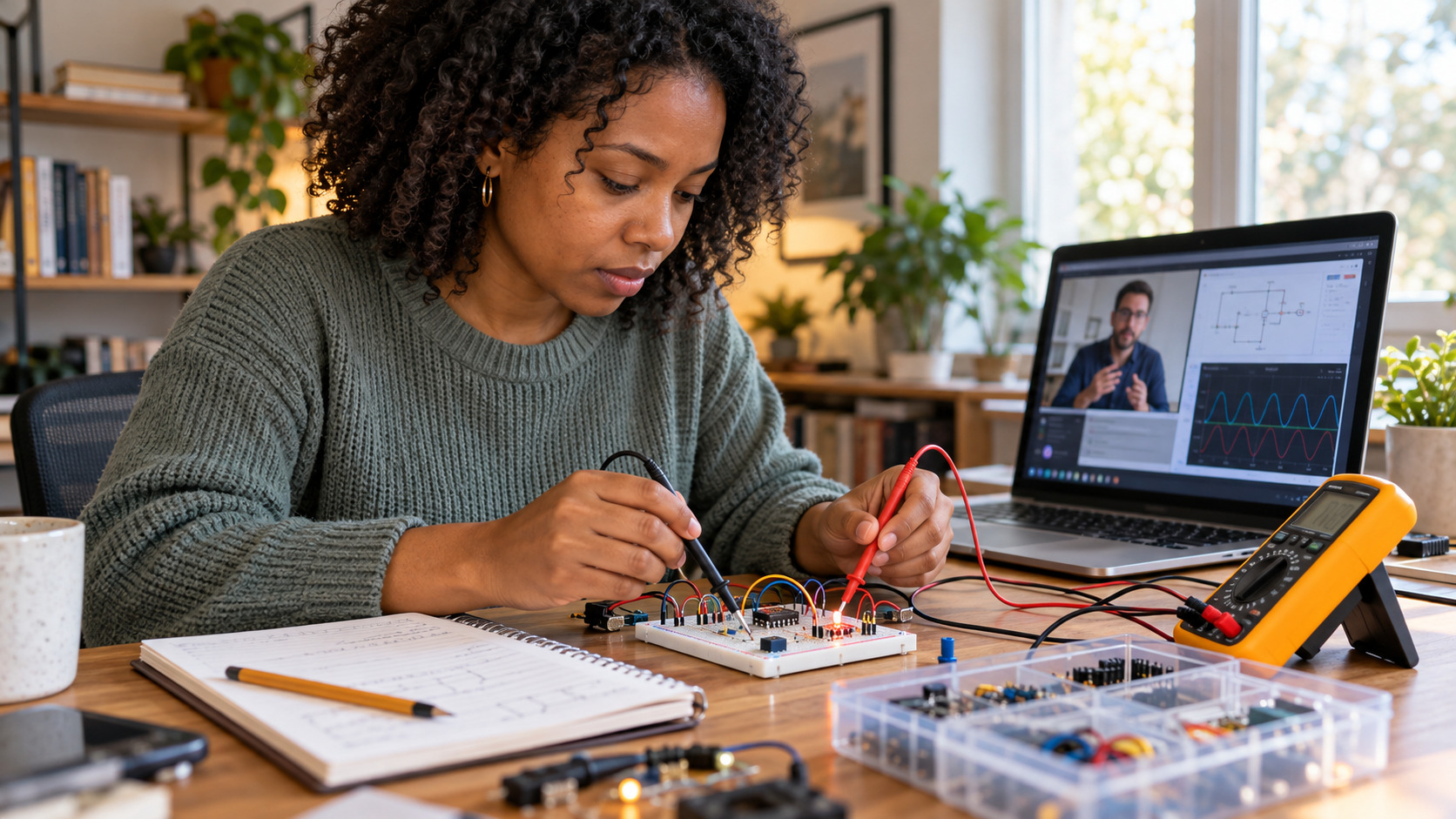
The traditional image of an engineering student often involves a sterile laboratory, the hum of machinery, and the scent of chemicals. For decades, hands-on experience in these physical spaces has been the bedrock of engineering education. However, the rise of online learning programs presents a significant challenge: how can we replicate or even enhance this crucial practical component in a virtual environment? This article explores the evolving landscape of engineering education, focusing on how laboratories are being reimagined for the digital age.
Key Takeaways
- Online engineering labs can combine software simulations, remote operation of real equipment, and collaborative design work.
- Simulation makes repeated experiments easier, but instrument handling and some physical skills still require hands-on experience.
- Strong online labs need meaningful experiments, feedback, assessment, technical support, and access to instructors.
The Imperative for Evolution
The shift towards online education is not a fleeting trend but a fundamental realignment in how we access and deliver knowledge. While online programs offer unparalleled flexibility and accessibility, the question of practical skill development remains a central concern for many aspiring engineers and their future employers. The very essence of engineering is about tangible application, about bridging the gap between theoretical understanding and real-world problem-solving. This necessitates a re-evaluation of how we facilitate that bridge when physical proximity to a laboratory is no longer a given.
Digital Transformation of Learning
The digital revolution has permeated every facet of our lives, and education is no exception. The pandemic accelerated this transformation, forcing institutions to innovate rapidly. This has created an opportunity to rethink not just how we teach engineering, but also where and when students engage with practical concepts. The inertia of tradition can be a powerful force, but the demands of a globalized, digitally-driven world require us to be agile.
Addressing the Accessibility Gap
For many, online programs unlock doors to engineering education that were previously shut. Geographic limitations, work commitments, and personal responsibilities often make attending a traditional, on-campus program infeasible. By developing robust online laboratory experiences, we can democratize access to high-quality engineering education, fostering a more diverse and inclusive future engineering workforce. This is not about replacing the physical lab, but about extending its reach and impact.
Reimagining the Virtual Laboratory
The concept of a “virtual laboratory” is not new, but its sophistication and widespread implementation have been dramatically enhanced by advancements in technology. Gone are the days of rudimentary simulations. Today’s virtual labs are increasingly immersive, interactive, and capable of delivering a rich learning experience.
Simulation Software: The Foundation
At the heart of many online engineering labs lies advanced simulation software. These platforms allow students to model and test complex systems, from electrical circuits and fluid dynamics to mechanical structures and chemical reactions. The beauty of simulation is its ability to let students experiment without the constraints of physical resources or the risks associated with real-world experimentation. They can push the boundaries, break things (virtually, of course), and learn from the consequences without incurring significant costs or danger.
Circuit Simulators: From Theory to Practice
For electrical engineering students, tools like SPICE (Simulation Program with Integrated Circuit Emphasis) and its modern descendants are invaluable. These allow students to design, build, and test virtual circuits, observing voltage, current, and waveform responses in real-time. They can swap components, alter parameters, and analyze the behavior of their designs before ever touching a breadboard.
Mechanical and Civil Engineering Simulations
In mechanical and civil engineering, finite element analysis (FEA) software enables students to simulate stress, strain, and deformation in structures. This allows them to understand the principles of structural integrity and material behavior under various loads. Similarly, fluid dynamics simulations help visualize and analyze fluid flow, crucial for designing efficient engines, aircraft, and pipelines.
Virtual Reality (VR) and Augmented Reality (AR): Immersive Experiences
The integration of Virtual Reality (VR) and Augmented Reality (AR) is a game-changer for online engineering labs. VR can transport students into a fully immersive, three-dimensional laboratory environment. Imagine a student donning a VR headset and finding themselves standing in a virtual chemical plant, able to interact with equipment, perform experiments, and troubleshoot problems as if they were physically present.
VR for Complex Procedures
VR is particularly effective for teaching complex or hazardous procedures. For instance, a student learning to operate intricate machinery or perform delicate surgical procedures on robotic systems can practice repeatedly in a safe, virtual space, building muscle memory and confidence. This can significantly reduce the learning curve and the potential for errors in real-world scenarios.
AR for Contextual Learning
Augmented Reality, on the other hand, overlays digital information onto the real world. An AR app could allow a student working with a physical device at home to point their tablet at it and see real-time sensor data, schematics, or troubleshooting guides appear on their screen. This bridges the gap between the digital and physical, providing contextual information precisely when and where it’s needed.
Remote Access to Physical Labs
While virtual labs offer immense possibilities, there are certain experiments that, by their very nature, require interaction with physical equipment. For these instances, remote access to physical laboratories is becoming an increasingly viable solution. Universities and specialized labs are establishing systems where students can control and operate real-world equipment from their own computers.
The Rise of the “Tele-Lab”
These “tele-labs” allow students to remotely access instruments, conduct experiments, and collect data. This is particularly beneficial for disciplines that involve specialized, expensive, or dangerous equipment that cannot be replicated in every student’s home. Think of access to particle accelerators, high-powered lasers, or advanced manufacturing equipment.
Challenges and Opportunities in Remote Operation
Operating physical equipment remotely presents its own set of challenges, including latency, network stability, and the need for robust remote control systems. However, it also opens up opportunities for collaboration with industry partners and access to cutting-edge research facilities that might otherwise be inaccessible to students.
Bridging the Gap: Pedagogical Approaches
The technology is only one piece of the puzzle. The success of online engineering labs hinges on thoughtful pedagogical design. Simply porting a traditional lab manual online will not suffice. Educators must reimagine how they structure activities, provide feedback, and assess student learning in a virtual context.
Guided Inquiry and Problem-Based Learning
Online labs can be powerful platforms for guided inquiry and problem-based learning. Instead of providing step-by-step instructions, educators can present students with a real-world problem or a set of objectives and guide them through the process of designing, simulating, and analyzing their own solutions. This fosters critical thinking and encourages students to take ownership of their learning.
Designing Experiments Digitally
Students can be tasked with designing virtual experiments to test hypotheses, optimize parameters, or troubleshoot a malfunctioning system. This requires them to understand the underlying principles and to creatively apply the tools available in the virtual environment.
Data Analysis and Interpretation
A significant portion of engineering work involves analyzing and interpreting data. Online labs provide ample opportunities for students to collect, process, and visualize data from simulations or remote experiments, developing essential data science skills.
Collaborative Learning in a Virtual Space
Collaboration is a cornerstone of engineering practice. Online platforms can facilitate collaboration among students, even when they are physically dispersed.
Virtual Project Teams
Students can form virtual project teams, using shared online workspaces, collaborative design tools, and video conferencing to work together on complex projects. This mirrors the collaborative environments found in modern engineering workplaces.
Peer Review and Feedback
Online platforms can also be used for peer review of designs, code, and experimental results. This provides students with valuable feedback from their peers and develops their ability to critically evaluate the work of others.
Robust Assessment Strategies
Assessing learning in online labs requires a shift from traditional methods. While practical skills are important, the assessment must reflect the unique nature of the virtual environment.
Performance-Based Assessments
Instead of just grading a final report, assessments can focus on a student’s performance within the simulation or their ability to achieve specific outcomes using remote equipment. This could involve successfully completing a complex simulation task or achieving a target result with a remote robotic arm.
Portfolios of Digital Work
Students can build digital portfolios showcasing their simulation projects, design iterations, data analysis reports, and reflections on their learning process. This provides a comprehensive view of their practical skills and understanding.
The Human Element: Facilitation and Support
Technology alone cannot replace the role of the instructor or the value of human interaction in the learning process. For online engineering labs to be truly effective, they must be supported by dedicated instructors and robust student support systems.
The Evolving Role of the Instructor
The instructor in an online engineering program becomes more of a facilitator, guide, and mentor. They are responsible for designing engaging learning experiences, providing timely and constructive feedback, and fostering a sense of community among students.
Beyond Technical Expertise
While technical expertise remains crucial, online instructors also need strong pedagogical skills, including proficiency in using online learning platforms and a deep understanding of how to motivate and support students in a remote setting.
Instructor as Coach
Think of the instructor as a coach, guiding students through complex challenges, providing strategic advice, and helping them overcome obstacles. They are not just dispensing information but empowering students to learn and grow.
Building Community and Engagement
Creating a sense of community among online learners is vital for engagement and retention. This can be achieved through various means.
Virtual Office Hours and Discussion Forums
Regular virtual office hours and active discussion forums allow students to interact with their instructors and peers, ask questions, and share their experiences.
Group Projects and Study Sessions
Structured group projects and optional virtual study sessions can foster peer-to-peer learning and a sense of camaraderie.
The Future Landscape: Continuous Innovation
The field of online engineering education is not static. As technology continues to evolve, so too will the possibilities for virtual and remote laboratories. The key to success lies in a commitment to continuous innovation and adaptation.
The Convergence of Disciplines
Future online labs may see a greater convergence of different engineering disciplines. Students might be able to simulate and test integrated systems that involve mechanical, electrical, and software components, reflecting the interdisciplinary nature of modern engineering challenges.
AI-Powered Tutoring and Feedback
Artificial intelligence (AI) has the potential to revolutionize online learning. AI-powered tutors could provide instant feedback on student work, offer personalized learning paths, and identify areas where students might be struggling, freeing up instructors to focus on higher-level guidance.
Gamification and Immersive Storytelling
The principles of game design and immersive storytelling can be incorporated into online labs to make learning more engaging and memorable. Imagine solving engineering puzzles within a compelling narrative or earning badges for mastering complex skills.
The Ongoing Debate: Physical vs. Virtual
It’s important to acknowledge that the debate about the efficacy of online versus physical labs will continue. For certain highly specialized fields or for the development of very specific fine motor skills, the physical laboratory may remain indispensable. However, for a significant portion of engineering education, online and remote labs are proving to be not just a viable alternative but a powerful and transformative approach. The future likely involves a hybrid model, where the strengths of both physical and virtual environments are leveraged to provide the most comprehensive and accessible engineering education possible. This reimagining is not about replacing the tangible, but about expanding its reach and ensuring that the next generation of engineers is equipped with the skills and knowledge to tackle the complex challenges of our rapidly changing world.


