
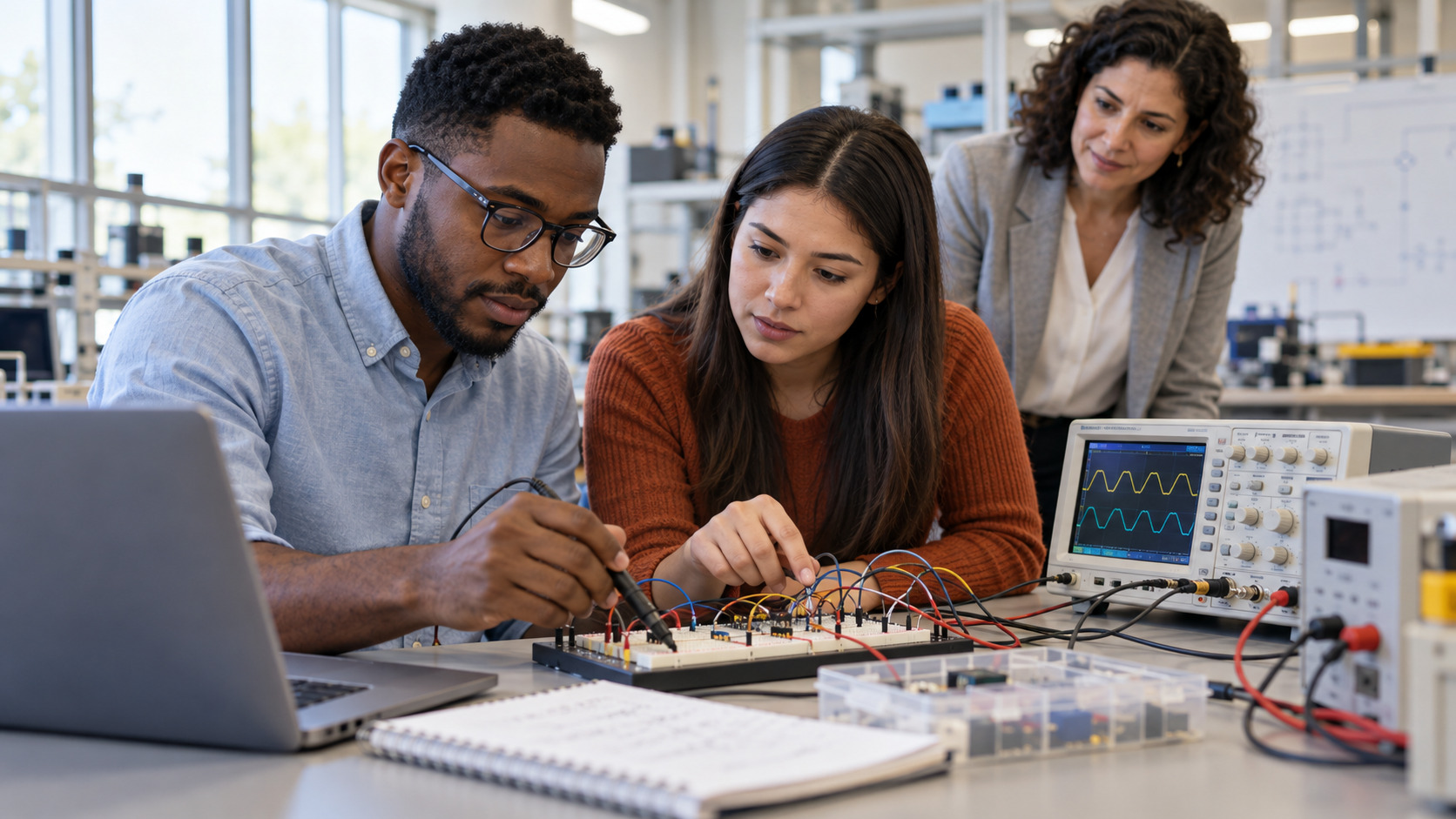
So, you’re considering a degree in Electrical and Computer Engineering (ECE)? Or perhaps you’re already enrolled and curious about the journey ahead? This field is a cornerstone of modern technology, essentially the brain and nervous system of our digital world. From the microchips in your smartphone to the vast power grids that light up cities, ECE professionals are at the forefront of innovation. This article will guide you through the core courses you’ll likely encounter in an ECE curriculum, giving you a realistic preview of the knowledge and skills you’ll acquire. We’ll break down the often-complex world of ECE into manageable chunks, helping you understand the foundational principles and specialized areas that make this discipline so vital.
Key Takeaways
- An ECE curriculum builds from calculus, differential equations, linear algebra, and physics into circuits, signals, digital logic, and programming.
- Advanced options can include photonics, robotics, power systems, and renewable energy, usually after prerequisite courses.
- Senior design brings hardware, software, teamwork, prototyping, testing, and presentation skills together in a substantial project.
The Foundational Pillars: Building Your Engineering Bedrock
Think of these initial courses as the concrete and steel beams upon which your entire engineering edifice will be built. Without a solid understanding of these fundamental principles, the more advanced concepts will remain elusive. These are not just introductory classes; they are the bedrock for everything that follows.
Mathematics for Engineers: The Universal Language
Mathematics is not just a tool in engineering; it’s the language. You will find yourself constantly applying mathematical concepts, from basic algebra to advanced differential equations, to solve real-world problems. It’s the framework for understanding and modeling physical phenomena.
- Calculus I, II, and III (Multivariable Calculus): This series is non-negotiable. You’ll learn about derivatives, integrals, and their applications in analyzing rates of change, areas, volumes, and optimization. Multivariable calculus extends these concepts to functions of several variables, essential for understanding fields, forces, and multi-dimensional systems. Imagine trying to design an antenna without understanding how electromagnetic waves propagate in three dimensions – it would be like trying to speak without a vocabulary.
- Differential Equations: Many physical systems in ECE, from circuits with capacitors and inductors to control systems, are described by differential equations. This course teaches you how to solve these equations, providing the means to predict system behavior over time. It’s the bridge between a static diagram and a dynamic, evolving system.
- Linear Algebra: Essential for understanding signal processing, control systems, machine learning, and computer graphics. You’ll work with vectors, matrices, eigenvalues, and eigenvectors. Think of it as the organizational system for complex data, allowing you to manipulate and analyze large sets of information efficiently.
Physics: The Rules of the Universe
Physics provides the fundamental laws governing the universe, and in ECE, you’ll be particularly focused on electromagnetism and mechanics. These courses provide the theoretical basis for why components behave the way they do.
- General Physics (Mechanics, Thermodynamics, Electricity & Magnetism): While mechanics and thermodynamics provide a broad scientific context, the electricity and magnetism portion is paramount for ECE. You’ll delve into Coulomb’s law, electric fields, magnetic fields, Faraday’s law, and Maxwell’s equations. These equations are the bedrock of electrical engineering, explaining everything from how a wire carries current to how wireless communication works. It’s like learning the gravity and inertia of the electrical world.
The Electrical Core: Circuitry and Signals
Once you have a strong mathematical and physical foundation, you’ll start diving into the heart of electrical engineering. These courses focus on the analysis and design of circuits and the manipulation of signals.
Circuit Analysis: Decoding the Flow
This is often where students truly begin to feel like electrical engineers. You’ll learn the fundamental principles that govern how electricity behaves in circuits.
- DC and AC Circuit Analysis: You’ll start with direct current (DC) circuits, learning about Ohm’s law, Kirchhoff’s laws, series and parallel components, and basic circuit theorems (Thevenin, Norton, Superposition). Then, you’ll transition to alternating current (AC) circuits, introducing concepts like impedance, phasors, and frequency response, which are critical for understanding how signals are processed and transmitted. This is where you learn to read the blueprints of electrical systems, understanding how power and information flow.
- Electronics I (Analog Electronics): This course introduces semiconductor devices like diodes, transistors (BJT and MOSFET), and operational amplifiers. You’ll learn how these components are used to build amplifiers, filters, and other fundamental analog circuits. This is where you start to understand the internal workings of the components that make modern electronics possible. It’s like understanding the gears and levers that make a complex machine move.
Signals and Systems: The Language of Information
Signals are the carriers of information, and systems are what process these signals. This area is crucial for communication, control, and data processing.
- Signals and Systems: This course introduces continuous-time and discrete-time signals, linear time-invariant (LTI) systems, convolution, Fourier series, Fourier transforms, and Laplace transforms. These mathematical tools are essential for analyzing how systems modify signals and for understanding concepts like frequency content and system stability. This is where you learn to speak the language of information, understanding how sound, images, and data are represented and manipulated.
- Digital Signal Processing (DSP): Building on Signals and Systems, DSP focuses on the processing of discrete-time signals using digital computers. You’ll learn about sampling, quantization, discrete Fourier transform (DFT), fast Fourier transform (FFT), and digital filter design. DSP is fundamental to audio processing, image processing, telecommunications, and countless other applications. Think of it as refining raw information into a clear, usable format.
The Computer Core: Logic, Architecture, and Software
This facet of the ECE curriculum blends the electrical principles with the logic and design of computing systems, bridging the gap between hardware and software.
Digital Logic Design: The Building Blocks of Computing
This is where you move from the continuous world of analog signals to the discrete world of 0s and 1s, the foundation of all digital computers.
- Digital Logic Design: You’ll learn about Boolean algebra, logic gates (AND, OR, NOT, XOR), combinational logic circuits (adders, multiplexers, decoders), and sequential logic circuits (flip-flops, registers, counters). You’ll often use hardware description languages (HDLs) like VHDL or Verilog to design and simulate these circuits. This is essentially learning the alphabet and grammar of how computers think, at their most fundamental level.
- Computer Architecture and Organization: This course dives into the structure of a computer system. You’ll learn about central processing units (CPUs), memory hierarchies (caches, RAM), input/output (I/O) systems, and instruction sets. Understanding how these components interact is crucial for designing efficient and powerful computing systems. It’s like understanding the blueprint of a building, knowing where each room is and how they connect.
Programming and Data Structures: Bringing Logic to Life
While ECE is often perceived as hardware-focused, strong programming skills are indispensable for almost any specialization within the field.
- Programming Fundamentals (e.g., C/C++, Python): You’ll likely start with an introductory programming course, focusing on procedural programming concepts, data types, control structures, functions, and basic algorithms. C/C++ is often favored for its low-level control and performance, while Python is increasingly used for its versatility and ease of use in areas like data science and machine learning. This is where you learn to give instructions to the computer, transforming abstract ideas into executable code.
- Data Structures and Algorithms: This course teaches you about efficient ways to store and organize data (arrays, linked lists, trees, graphs) and how to design and analyze algorithms for solving computational problems. Understanding these concepts is critical for writing efficient and scalable software, whether for embedded systems or large-scale data processing. It’s like learning how to organize your toolbox effectively so you can quickly find the right tool for any job.
Specializations and Advanced Topics: Forging Your Path
As you progress, the curriculum will broaden, allowing you to delve deeper into specific areas of ECE that pique your interest. These advanced courses often have prerequisites from the foundational and core subjects.
Electromagnetics and Photonics: Harnessing Waves and Light
This area deals with the fundamental principles of electromagnetic waves and their application, including optics and wireless communication.
- Electromagnetic Fields and Waves: Building on the physics of E&M, this course delves into Maxwell’s equations in more detail, wave propagation in different media, transmission lines, waveguides, and antennas. This knowledge is essential for designing communication systems, radar, and other high-frequency applications. It’s where you learn to sculpt invisible waves, making them carry information across vast distances.
- Optics and Photonics: This specialization explores the generation, manipulation, and detection of light. You might study lasers, optical fibers, integrated optics, and optoelectronic devices, which are crucial for high-speed data communication, medical imaging, and sensing. This is about harnessing light not just to see, but to transmit data and perform intricate measurements.
Control Systems and Robotics: Intelligent Automation
Control systems are about making systems behave predictably and autonomously, a key element in everything from cruise control in cars to robotic arms in factories.
- Control Systems: This course introduces feedback control theory, stability analysis, system modeling (transfer functions, state-space), and controller design (PID, lead-lag compensators). You’ll learn how to design systems that maintain desired outputs despite disturbances. It’s like teaching a machine to self-correct, to stay on course even when faced with obstacles.
- Robotics: Often an interdisciplinary field, robotics courses in ECE focus on the electrical and computational aspects of robot design, including kinematics, dynamics, sensors, actuators, and motion planning. You might learn about computer vision for robots or embedded systems for robot control. This is where you bring inanimate objects to life, giving them the ability to perceive, think, and act.
Power Systems and Renewable Energy: Powering the Future
This area focuses on the generation, transmission, distribution, and utilization of electrical power, with a growing emphasis on sustainable sources.
- Power Systems Analysis: You’ll study the components of a power grid, including generators, transformers, transmission lines, and loads. Topics include power flow analysis, fault analysis, and power system stability. This is about understanding the massive infrastructure that keeps our world running, from the power plant to your wall outlet.
- Renewable Energy Systems: This specialization focuses on technologies like solar photovoltaics, wind turbines, fuel cells, and energy storage systems. You’ll learn about their design, integration into the grid, and economic considerations. It’s about designing the future of energy, moving towards a more sustainable and resilient power infrastructure.
The Capstone Project: Synthesizing Your Knowledge
Towards the end of your degree, most ECE programs culminate in a capstone project. This is your opportunity to apply all the knowledge and skills you’ve acquired to design, build, and test a real-world engineering solution.
- Senior Design Project: This often year-long project involves working in teams, simulating a professional engineering environment. You’ll define a problem, research solutions, design a system (hardware, software, or both), build and test prototypes, and present your findings. This is your magnum opus, the culmination of your studies where you demonstrate your ability to innovate and solve complex problems. It’s where all the disparate pieces of your education come together to form a coherent, functional whole.
Beyond the Classroom: Continuous Learning
The ECE field is incredibly dynamic, with new technologies and methodologies emerging constantly. Your degree provides a strong foundation, but the learning doesn’t stop after graduation. Continuous learning through professional development, online courses, and staying current with industry trends is crucial for a successful and evolving career in ECE. Embrace the challenge, for the world of Electrical and Computer Engineering is vast, intricate, and perpetually exciting.


