
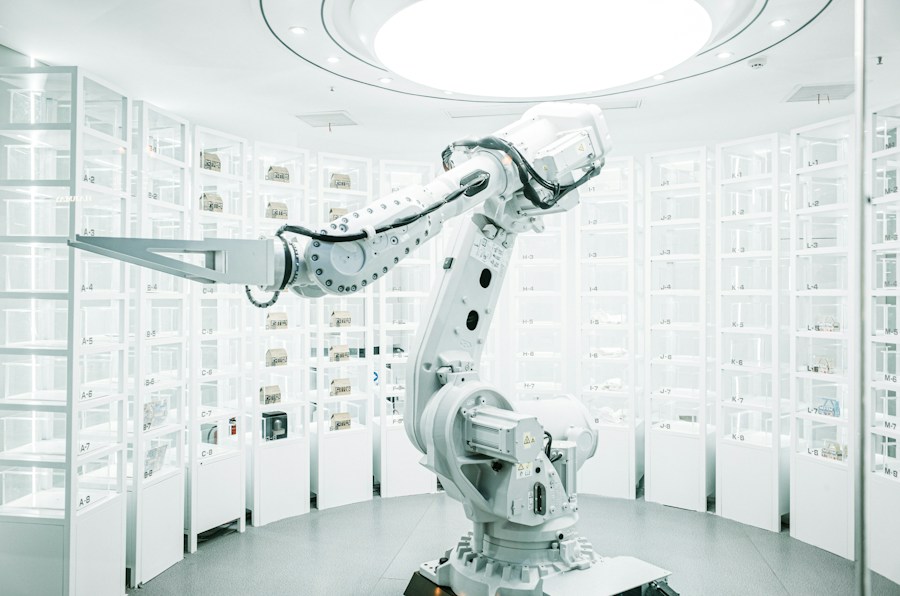
How do robots achieve their seemingly effortless movements and complex tasks? The answer lies in the intricate world of control systems, a domain where Electrical and Computer Engineering (ECE) principles are the bedrock. This article will delve into how ECE powers the precision and performance that define modern robotics, equipping you with a foundational understanding of this critical field.
Key Takeaways
- Robot control connects sensors, a controller, and actuators to turn a desired action into physical movement.
- Closed-loop control uses measured feedback to adjust behavior; PID performance depends on suitable tuning and the system being controlled.
- Practical robotics combines control models with perception, motion planning, embedded hardware, and timing-aware software.
The Heartbeat of Automation: Fundamentals of Robotic Control
At its core, a control system in robotics is analogous to a nervous system, translating high-level commands into precise physical actions. It’s the unseen architect behind a robot’s ability to navigate, manipulate, and interact with its environment. Without sophisticated control, a robot is merely a collection of inert parts.
The Feedback Loop: The Robot’s Sensory Awareness
Imagine a chef tasting their soup before adding more salt. This tasting is a form of feedback. In robotics, sensors act as the chef’s taste buds, continuously gathering information about the robot’s state (position, velocity, temperature, etc.) and its environment. This data is then fed back to the controller, which compares it to the desired state and makes necessary adjustments.
Types of Sensors: The Robot’s Eyes and Ears
- Proprioceptive Sensors: These sensors measure the internal state of the robot. Examples include encoders (measuring joint angles and rotation) and accelerometers (detecting motion and orientation). They tell the robot “how it’s doing.”
- Exteroceptive Sensors: These sensors perceive the external environment. This category encompasses a wide range, including cameras (vision), lidar (distance sensing using lasers), ultrasonic sensors (distance sensing using sound waves), and force/torque sensors (detecting contact and pressure). They tell the robot “what’s around it.”
The Role of the Controller: The Brain’s Decision-Maker
The controller is the central processing unit of the control system. It receives the desired task and the sensor data, processes them using algorithms, and generates commands for the robot’s actuators. This is where the “intelligence” of the robot truly resides, transforming raw sensor data into actionable instructions.
Actuators: The Muscles of the Machine
Actuators are the components that translate the controller’s electrical signals into physical motion. Think of them as the robot’s muscles, executing the commands.
Common Actuator Types
- Electric Motors: The most prevalent type, electric motors convert electrical energy into rotational or linear motion. Different types like DC, AC, stepper, and servo motors offer varying levels of precision, torque, and speed control, each suited for different robotic applications.
- Hydraulic and Pneumatic Actuators: These systems use pressurized fluids (hydraulic) or air (pneumatic) to generate force and motion. They are often used in applications requiring high power or specific types of movement, like industrial robots for heavy lifting.
Navigating Complexity: Different Control Strategies
Robots operate in diverse environments and perform a multitude of tasks, necessitating a range of control strategies to achieve optimal performance. The choice of strategy often depends on the robot’s complexity, the task’s requirements, and the available computational resources.
Open-Loop Control: The Unwavering March
In an open-loop system, the controller’s output is independent of the system’s output. Imagine a simple toaster: you set the time, and it toasts for that duration, regardless of how brown the toast actually is. While simple and computationally inexpensive, open-loop control is highly susceptible to disturbances and inaccuracies. It lacks the ability to self-correct.
When Open-Loop is Sufficient
- Predictable Environments: When the robot operates in a highly controlled and predictable environment where external disturbances are minimal.
- Simple, Repetitive Tasks: For tasks that require a fixed sequence of movements without the need for adaptation.
Closed-Loop Control: The Adaptive Navigator
Closed-loop control, also known as feedback control, is the workhorse of modern robotics. Here, the controller continuously monitors the system’s output (via sensors) and uses this information to adjust its input, ensuring the output remains close to the desired setpoint. This is akin to a thermostat regulating room temperature.
Proportional-Integral-Derivative (PID) Control: The Classic Workhorse
PID controllers are a cornerstone of closed-loop control. They calculate an error value as the difference between a desired setpoint and a measured process variable and apply a correction based on three terms:
- Proportional (P) Term: Responds to the current error. A larger error leads to a larger correction.
- Integral (I) Term: Accumulates past errors. This helps eliminate steady-state errors (the persistent offset between the desired and actual output).
- Derivative (D) Term: Predicts future errors based on the rate of change of the error. This helps dampen oscillations and improve stability.
Tuning PID Controllers: Finding the Sweet Spot
The effectiveness of a PID controller hinges on properly “tuning” its three gains (Kp, Ki, Kd). Poor tuning can lead to sluggish responses, oscillations, or instability. Tuning is often an iterative process, involving empirical methods or more advanced analytical techniques.
Advanced Control Techniques: Beyond the Basics
As robotic tasks become more sophisticated, so too do the control strategies. ECE graduates often delve into these advanced methods to push the boundaries of robotic capability.
Model-Based Control: Knowing the Robot’s Physics
These controllers leverage a mathematical model of the robot’s dynamics (how it moves and interacts with forces). By understanding the robot’s physical properties, the controller can predict its behavior and generate more accurate and efficient control signals.
- Inverse Dynamics Control: This technique uses the robot’s dynamic model to calculate the actuator torques or forces required to achieve a desired acceleration.
- Computed Torque Control: A specific form of inverse dynamics control that aims to linearize and decouple the robot’s motion, simplifying the control problem.
Adaptive Control: Learning and Evolving
Adaptive controllers can adjust their parameters online as the robot operates, allowing them to compensate for uncertainties in the robot’s model or changes in the environment. This is crucial for robots that operate in dynamic or uncertain conditions.
Robust Control: Withstanding Uncertainty
Robust control design aims to ensure satisfactory performance even in the presence of significant modeling errors or external disturbances. It’s about building controllers that are resilient to the unexpected.
Perception and Planning: Enabling Intelligent Action
Beyond simply controlling movement, robots need to perceive their environment and plan their actions. ECE plays a vital role in these higher-level functions, bridging the gap between raw sensor data and purposeful behavior.
Computer Vision: The Robot’s Sight
Computer vision systems enable robots to “see” and interpret their surroundings. This involves processing images from cameras to identify objects, track their movement, and understand the scene’s layout.
Key ECE Contributions in Computer Vision
- Image Processing Algorithms: Techniques for noise reduction, edge detection, feature extraction, and image segmentation.
- Machine Learning and Deep Learning: Modern vision systems heavily rely on neural networks trained on vast datasets to perform tasks like object recognition, pose estimation, and scene understanding.
- Sensor Fusion: Combining data from multiple vision sensors (e.g., stereo cameras) or integrating vision with other sensor modalities (e.g., lidar) to create a more comprehensive understanding of the environment.
Path Planning and Navigation: Charting the Course
Once a robot perceives its environment, it needs to figure out how to get from point A to point B, avoiding obstacles. Path planning algorithms generate a collision-free trajectory for the robot to follow.
Popular Path Planning Algorithms
- **A\* Search Algorithm:** A well-known graph traversal algorithm that efficiently finds the shortest path between two points in a discrete grid.
- RRT (Rapidly-exploring Random Tree): Particularly effective in high-dimensional configuration spaces, RRTs build a tree of possible paths by randomly sampling points in the space.
- Potential Fields: This method treats the goal as an attractive force and obstacles as repulsive forces, guiding the robot towards the goal while avoiding collisions.
Motion Planning: Generating Smooth and Executable Movements
Path planning often yields a geometric path. Motion planning then takes this path and generates a time-parameterized trajectory that the robot’s actuators can realistically follow, considering its velocity, acceleration, and kinematic constraints.
The ECE Toolkit: Hardware and Software Foundations
The successful implementation of robotic control systems relies on a robust interplay of hardware and software, both deeply rooted in ECE disciplines.
Students exploring this foundation can compare a Bachelor of Science in Electrical and Computer Engineering, checking the current curriculum for relevant coursework, labs, and project opportunities.
Embedded Systems: The Robot’s Mini-Brains
Embedded systems are specialized computer systems designed for a specific function within a larger device. In robotics, they often serve as the primary controllers, processing sensor data, executing control algorithms, and driving actuators.
Microcontrollers and Microprocessors
- Microcontrollers: These are integrated circuits that contain a processor, memory, and programmable input/output peripherals on a single chip. They are ideal for real-time control tasks due to their low power consumption and dedicated hardware.
- Microprocessors: More powerful than microcontrollers, microprocessors are the brains behind more complex robotic systems, often running operating systems and handling sophisticated computations.
Real-Time Operating Systems (RTOS): Orchestrating Complex Tasks
Robotic control demands precise timing and predictable execution. Real-Time Operating Systems (RTOS) are designed to handle tasks with strict deadlines, ensuring that critical operations are performed within their allocated time windows.
Key RTOS Concepts for Robotics
- Task Scheduling: Prioritizing and managing multiple concurrent tasks to ensure timely execution of critical functions.
- Interrupt Handling: Efficiently responding to external events from sensors or other system components.
- Inter-Process Communication (IPC): Mechanisms for different parts of the robot’s software to exchange information safely and efficiently.
Software Frameworks and Libraries: Accelerating Development
ECE engineers leverage a wealth of software frameworks and libraries to streamline the development of robotic control systems.
The ROS Ecosystem: A Game Changer
The Robot Operating System (ROS) is an open-source, flexible framework for writing robot software. It provides a rich set of tools, libraries, and conventions that simplify the development of complex robotic applications, from low-level device control to high-level AI.
- ROS Nodes: Independent processes that perform specific tasks (e.g., sensor driver, controller).
- Topics and Messages: A publish-subscribe communication mechanism for nodes to exchange data.
- Services and Actions: Mechanisms for request-response and long-running task interactions between nodes.
Future Frontiers: Evolving Control in Robotics
The field of robotic control is in constant evolution, driven by advancements in ECE and the ever-increasing demands of complex applications.
Machine Learning in Control: Learning from Experience
The integration of machine learning with control systems is a rapidly growing area. Robots are increasingly being trained to learn control policies directly from data, allowing them to adapt to novel situations and perform tasks that are difficult to model analytically.
Reinforcement Learning for Robotics
Reinforcement learning (RL) enables robots to learn optimal control strategies through trial and error, receiving rewards or penalties for their actions. This is particularly promising for tasks involving complex interactions with the environment.
Human-Robot Interaction (HRI): Seamless Collaboration
As robots become more integrated into human environments, ECE is crucial for developing control systems that facilitate intuitive and safe human-robot collaboration. This involves understanding human intent, adapting to human behavior, and providing clear feedback.
Intent Recognition and Predictive Control
- Intent Recognition: Using sensors and AI to infer what a human operator wants the robot to do.
- Predictive Control: Control strategies that anticipate human actions and adjust the robot’s behavior proactively to ensure safety and efficiency.
Dexterous Manipulation and Grasping: The Delicate Touch
Achieving human-like dexterity in robotic manipulation and grasping remains a significant challenge. ECE is at the forefront of developing advanced control algorithms and sensor systems to enable robots to handle delicate objects with precision and adapt to varying object properties.
Force and Tactile Sensing for Grasping
- Force Sensors: Measuring the forces applied during grasping to avoid crushing objects.
- Tactile Sensors: Providing rich information about the contact surface, allowing for more nuanced and adaptive grasps.
In conclusion, the mastery of precision and performance in robotics is inextricably linked to the principles and innovations within Electrical and Computer Engineering. From the fundamental feedback loops that give robots their awareness to the advanced algorithms that enable intelligent decision-making, ECE provides the essential building blocks for the robots of today and the intelligent machines of tomorrow. Understanding these control systems is not just about appreciating complex engineering; it’s about grasping how we are shaping the future of automation.


